


Main Takeaway: A crypto card is two layers stacked together. The payment rails are a commercial relationship between a card program and its partners, and that relationship has an operating lifespan. The balance is a separate question, and which side holds it is a design choice. Prepaid crypto cards keep your money inside the card program. Self-custody cards pull funds from your own wallet at the moment you tap. When the rails stop, that difference decides what happens next.
Quick reference
| Term | What it means |
|---|---|
| Crypto card | A payment card that draws on crypto holdings and settles at the register in local currency through a card network. |
| Payment rails | The chain of parties that carries a card payment, including the card program, an issuing processor, an issuing bank and a card network. |
| Card issuing infrastructure | The regulated middle layer that produces cards and connects them to a network. Often a different company from the wallet brand printed on the card. |
| Prepaid model | You load crypto or stablecoins into a balance that the card program controls, then spend down from that balance. |
| Real-time debit model | Your crypto stays in your own wallet, and the exact purchase amount is pulled at the moment of the transaction. |
| Insolvency estate | The asset pool that administrators of a wound-down company distribute to creditors. Customer balances the company was holding can land inside it. |
How do crypto debit cards work?
A crypto debit card solves one narrow problem. Paying a merchant from crypto usually means selling on an exchange, withdrawing to a bank, and waiting days for the transfer. A crypto debit card works by joining two systems that were built separately. The first is the card network that already runs in every payment terminal, so the merchant sees a normal card payment in local currency and needs to know nothing about crypto. The second is a funding and conversion step behind that payment, which decides where the money comes from at the instant of the swipe. Crypto cards suit people who hold crypto or stablecoins and want to pay everyday costs from those holdings.
The merchant side of a crypto card looks like any other card payment, which is what makes the product usable at all. The differences between crypto cards sit in the funding step behind that payment. Two cards can look identical in a wallet app, carry the same network logo and behave the same way at a coffee shop, while the money behind them sits in two different places.
Do crypto cards hold your crypto, or spend from it?
Crypto cards fall into three funding models, and the model decides who holds your balance when the card is idle. Reading which model a card uses takes a minute in the program's terms, and that minute answers most of the questions people ask after something goes wrong.
Prepaid cards, funded by a balance the program controls
A prepaid crypto card asks you to move crypto or stablecoins into the card program first. The program converts or holds that balance on your behalf until you spend it. Prepaid cards are the simplest model to operate and the easiest to onboard, because the program controls the money and can authorize a payment without touching a blockchain. The tradeoff is that your spending balance now sits on someone else's books, which makes you a customer of that company in the accounting sense as well as the product sense.
Exchange-linked cards, funded by your exchange account
An exchange-linked card debits the account you already hold at an exchange, converting at the moment of purchase. Exchange-linked cards remove a separate top-up step, and the fiat rails on the exchange side are usually well developed. The custody question does not change with this model, because an exchange account is a custodial account. Our guide to custodial and self-custodial wallets covers what that means for control and recovery.
Real-time debit cards, funded by your own wallet
A real-time debit card leaves your crypto in a wallet you control and pulls the exact purchase amount at the moment of the transaction. Real-time debit cards keep no spending float with the card program, so there is no balance on the program's books to load, reconcile or reclaim. The card becomes an instruction to your own wallet rather than an account you fund in advance, and the program's role narrows to routing the payment.
What happens if the company behind your crypto card shuts down?
What happens depends on where your balance was sitting when the shutdown started. If the card program held the balance, that balance becomes a claim against a company that is no longer operating. The timeline then belongs to administrators rather than to you. If the balance was in your own wallet, the card stops authorizing payments and the crypto stays reachable with your own keys. The table below states each model as a fact rather than a ranking, because these models fail in different directions and serve different needs.
| Question | Prepaid crypto card | Exchange-linked card | Real-time debit card | Ordinary bank debit card |
|---|---|---|---|---|
| Who holds the money when the card is idle | The card program | The exchange | You, in your own wallet | The bank |
| If the card issuer stops operating | Balance can enter the insolvency estate | Balance stays at the exchange, card access stops | Card stops authorizing, balance is untouched | Deposit insurance schemes may apply, subject to local limits |
| Who you need to trust | The card program and its issuing partners | The exchange and the card program | Your own key handling, plus the program for routing | The bank and its regulator |
| How money gets in | You top up in advance | Already in your exchange account | Nothing to top up, funds are pulled at purchase | Salary or bank transfer |
| What a service interruption can reach | Your spending balance and your card | Your card, while the exchange account continues | Your card only | Your card, while the deposit continues |
The July 2026 test of that difference
In late July 2026 the difference was tested in public. Kulipa, a card issuing infrastructure provider that several crypto wallets had built card programs on, entered insolvency proceedings and began winding down. On 28 July the cards running on that infrastructure stopped authorizing at the register, without advance notice to the people holding them. One affected program was a Solana wallet's card. That wallet published a notice telling users their funds were safe and that no action was needed. Per that wallet's official statement, the card was end-to-end self-custody, and each purchase pulled its exact amount from the user's wallet at the moment of the transaction. Balances had stayed with the users rather than with the card infrastructure provider.
On a prepaid card, the same insolvency would have found customer balances sitting inside the card program, where they would join the queue of an insolvency estate and wait on administrators. The rails are a business relationship. The balance is a design choice. The same provider had already shown the pattern in June 2026, when another wallet's card was suspended for users outside the EEA with roughly an hour of notice. Six weeks and two incidents describe a pattern rather than an accident, and commercial arrangements behind payment products have operating lifespans, which the BitMEX wind-down illustrated on the exchange side of the industry.
ELLIPAL Pay sits in the same category, so the same question applies to it. ELLIPAL Pay is a crypto Visa card, and ELLIPAL Pay depends on issuing and processing partners in the way that every crypto card does. A card program can lose a partner, change its regional coverage, or pause service, and wallet design does not prevent any of that. What the design settles is the funding layer. ELLIPAL Pay settles on-chain through a smart contract, so you spend from your own wallet without handing your funds to anyone. Our review of crypto security in the first half of 2026 collected a year of incident patterns across the industry. The losses that proved hardest to reverse were the ones where someone else was holding the money.
Which model fits how you spend?
- You buy coffee, transit and groceries with it. Small daily spending works on any of the three models, and a prepaid card is simple to run when you keep the loaded amount close to a week of expenses. A real-time debit card covers the same spending without parking a float anywhere.
- You are paid in stablecoins. Your income already arrives on-chain, so a real-time debit card removes the round trip through an exchange account and a bank transfer before you can spend it.
- You travel and need the card to work in several countries. Regional coverage and acceptance matter more than the custody model in this case. Check which regions a program actually serves before you depend on it, and carry a second payment method that does not share the same issuing infrastructure.
- You hold long term and spend occasionally. Keeping the bulk of your holdings in offline storage and funding a card from a separate, smaller spending wallet limits what any card outage or program change can reach.
- You are accepting payments as a merchant. The custody question moves to settlement, meaning who holds the funds between the sale and the payout, and in which currency the payout arrives.
- You are new to crypto cards. Start with an amount you can afford to have frozen for a while, because the common failure mode of a card program is a pause rather than a loss. Read the funding model before you load anything.
FAQ
Do crypto debit cards actually hold my crypto?
Some do and some do not, which is why the question is worth asking before you sign up. Prepaid card programs hold the balance you load until you spend it. Exchange-linked cards leave it in your custodial exchange account. Real-time debit cards leave it in a wallet you control and pull the purchase amount at the moment of the transaction. The program's terms state which of the three applies, usually in the section covering top-ups and settlement.
What happens to my money if the card company goes bankrupt?
The answer follows where the balance was sitting. A balance held by the card program becomes an unsecured claim in an insolvency process, where administrators set the timeline and the recovery amount is uncertain. A balance held in your own wallet is unaffected by the program's status, because the card was routing payments rather than holding funds. The card stops working while the crypto stays reachable with your recovery phrase. Losing card access and losing money are two separate events.
Is a crypto card safe to use?
A crypto card carries two distinct risks that are worth separating. Custody risk asks who holds your balance and what happens to it if that party stops operating. Operational risk asks whether the card keeps working, and self-custody funding does not close that second one, since every card depends on partners. Ordinary card considerations also apply, including fraud handling, disputed transactions and identity verification requirements. No self-custody arrangement removes every risk, and choosing the funding model decides which risks you carry.
What fees do crypto cards charge?
Crypto card fees usually fall into five categories. Those are card issuance, a monthly or maintenance charge, a currency conversion cost on non-local purchases, ATM withdrawal fees, and a blockchain network fee when an on-chain movement is part of the flow. Fee schedules differ by program and by region, so the published schedule for your specific card is the only reliable source. The ELLIPAL Pay card fees and limits page lists the current schedule for that program.
What happens if I lose my crypto card?
Freeze the card in the program's app first, then request a replacement through the same program. On a prepaid card the loaded balance stays with the program while you wait, so your access depends on the replacement process. On a real-time debit card the crypto stays in your own wallet the whole time, and a lost card is a lost spending instrument rather than a lost key store. Keep your recovery phrase on a durable offline backup, and do not photograph it or type it into any website.
Can I use a crypto card without giving up my keys?
Yes, and that is what the real-time debit model does. The card authorizes a payment against a wallet you control, and the funds move at the moment of the purchase rather than sitting with the card program beforehand. ELLIPAL Pay works this way. ELLIPAL Pay settles on-chain through a smart contract, so you spend from your own wallet without handing your funds to anyone. ELLIPAL Pay is currently available in Europe and Latin America, and availability varies by region.
Why did some crypto cards stop working in 2026?
Several wallet-branded cards stopped authorizing in late July 2026 because a shared card issuing infrastructure provider entered insolvency proceedings and wound down its service. The same provider had suspended another wallet's card for users outside the EEA in June 2026 with roughly an hour of notice. Many wallet-branded cards run on a small number of issuing infrastructure providers, so one provider's status can interrupt several unrelated card brands at the same time, even when those brands compete with each other.
Crypto card vs paying from an exchange: what is the difference?
Paying from an exchange means selling your crypto there, withdrawing fiat to a bank account, then paying with a bank card, which typically takes days and keeps your funds custodial until the withdrawal completes. A crypto card compresses those steps into a single card authorization at the register. The custody difference depends on the card's funding model, since an exchange-linked card keeps your funds in the same custodial account while a real-time debit card keeps them in your own wallet until the purchase happens.
Trust layer
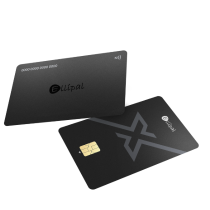
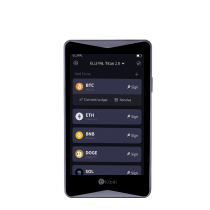
ELLIPAL has been on the market since 2018, with more than 1 million users across 140+ countries. ELLIPAL wallets support more than 10,000 tokens across 45+ blockchains and follow the BIP39 and BIP44 recovery standards, the industry formats that let a recovery phrase restore on compatible wallets from other brands. The ELLIPAL Titan 2.0 is an air-gapped cold wallet, with no Wi-Fi, no Bluetooth and no USB data connection, and transaction data crossing only as QR codes scanned by the device camera. The ELLIPAL X Card is an NFC cold wallet in credit-card form, with keys held in a CC EAL6+ secure chip. ELLIPAL Pay is a crypto Visa card available in Europe and Latin America. ELLIPAL is self-custodial across the product line, so key generation and backup stay with the owner. Different tools. Same mission.
Own it. Then use it.
Security note: No self-custody setup removes every risk. Holding your own keys closes the counterparty category of loss, and it does not eliminate physical, supply-chain, firmware, social-engineering, or user-error risks. ELLIPAL is a self-custody hardware wallet provider. It does not hold your funds, does not provide investment advice, and makes no promises about returns. Card, exchange, swap, and fiat services referenced here are operated by independent third parties, and availability varies by region, asset, and provider. Card programs depend on partners and can change coverage or pause service. Buy from an official source, store your recovery phrase on a durable offline backup kept separately from the device, do not share or digitally enter it, and verify every transaction before approving it. Product and service information reflects specifications as of 2026. Variants and regional terms may differ. This article is general educational information about how payment cards handle custody, not financial, investment, or custodial advice.