


Security Research

Hardware Wallet Data Leak: What It Exposes and What to Do
Main Takeaway: A customer data leak from a wallet store exposes order details such as your name, email, phone number and delivery address. It does not expose your seed phrase or private keys, because a hardware wallet creates those offline on the device. The risk that follows is phishing that quotes your real order details. Quick Reference Term What it means here Customer data leak A breach of a store's or reseller's order records, such as names, emails and shipping addresses. Seed phrase The 12 or 24 words, set by the BIP39 standard, that restore your wallet. Also called a recovery phrase. Phishing A message that imitates a trusted company to get you to reveal a secret or click a link. Spoofing Faking a sender name, email address or caller ID so a message looks official. What Does a Hardware Wallet Data Leak Expose? A hardware wallet data leak exposes the information you gave a store to buy and ship...

A Withdrawal Is a Request: What We Can Learn From Exchange Incidents
A balance on an exchange is a record in its ledger, and getting coins out is a request. A decade of exchange incidents, from Mt. Gox to Binance in October...
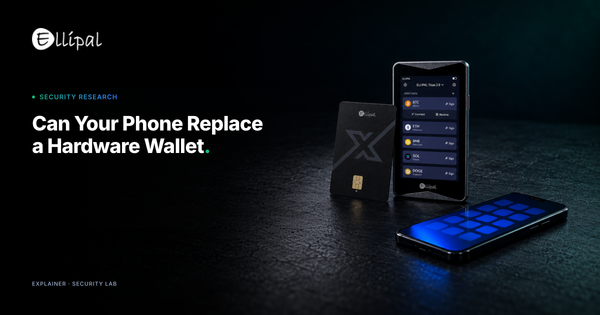
Can Your Phone Replace a Hardware Wallet?
A phone can store keys, but it also runs many apps and stays online. Here is what a hardware wallet separates from the phone, and what it does not cover,...

Crypto Hacks in September 2026: What Happened and What Self-Custody Covers
PeckShield counted $766.49M lost to 55 major hacks in September 2026. Most came from one exchange wallet system and one sidechain peg. What self-custody...
How ELLIPAL Hardware Is Built Against Supply Chain Attacks
A hardware wallet supply chain attack modifies a device before delivery. ELLIPAL answers it in layers, from a case built to resist opening and...
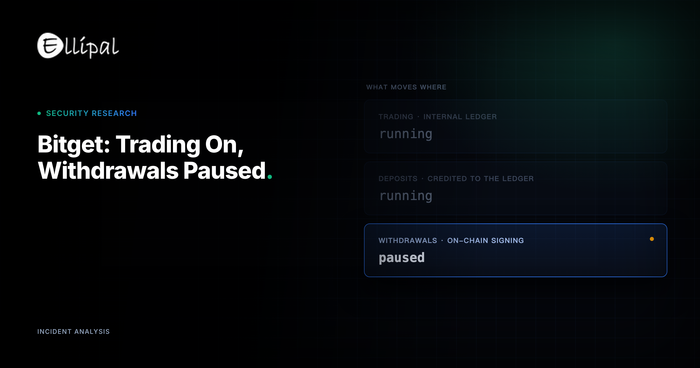
Bitget Hot Wallet Incident: Why Trading Continues While Withdrawals Are Paused
Bitget reported about $351.6 million in unauthorized hot wallet transfers on September 24, 2026. Withdrawals paused while trading continued. Here is why both can...
FomoPeek iOS Attack: What Crypto Wallet Users Should Do
FomoPeek 1.1 and 1.2 carried malicious modules capable of escaping the iOS sandbox. Learn what was exposed, what to do now and where hardware...
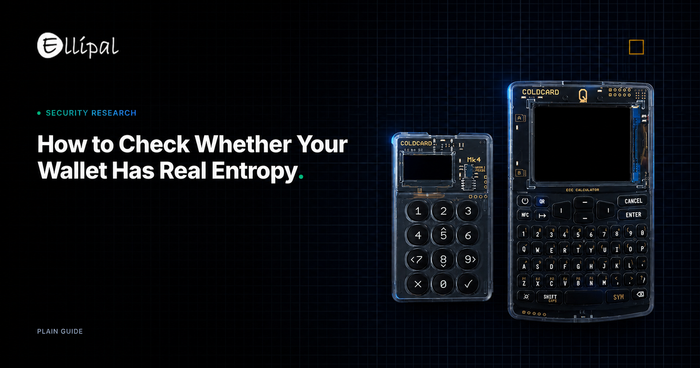
Seed Entropy: How to Check Whether Your Wallet Actually Has It
The Coldcard flaw was a silent build error: a software RNG stood in for the hardware one for five years. What happened, how ELLIPAL...
Crypto Security in 2025 and 2026: 5 Major Events and What They Mean for Self-Custody
From the Trust Wallet $7M browser hack to the Drift $285M multisig takeover, 5 events in 2025-2026 reshape what self-custody looks like in 2026....

Drift Protocol Hacked for $285M: What It Reveals About Exchange Risk
The Drift Protocol exploit proved "decentralized" doesn't mean safe. Here's why self-custody with a QR-only hardware wallet removes that counterparty risk.
North Korean Hackers Just Poisoned a Library Used by 83 Million Apps: Why Your Air-Gapped Wallet Didn't Flinch
North Korean hackers compromised Axios, an npm library downloaded 83 million times per week, injecting malware that targets crypto assets. Meanwhile, two teens drove...
Trust Wallet $7M Hack: What It Means for Wallet Security in 2026
$7 million stolen. 2,520 wallets drained. 48 hours. The Trust Wallet Christmas hack proved browser wallets are fundamentally vulnerable. With crypto theft hitting $3.4...