

Main Takeaway: A hardware wallet supply chain attack modifies a device before it reaches its owner, for example with an implant that reads the seed phrase from the screen. ELLIPAL answers it in layers: a case built to resist opening and show signs of it, plus a designed response to tampering, so owners can stop before setup.
From the start, we have designed ELLIPAL hardware around one assumption: someone may get their hands on a device before its owner does. ELLIPAL Titan has been air-gapped since 2018, and we treated that isolation as the first layer, with tamper resistance and tamper response built on top.
What happened in the Ledger implant case
Ledger said on October 9, 2026, that it was investigating reports of lost funds from users in Southeast Asia, and on October 10 it confirmed an unauthorized hardware implant in one affected user's device. In later updates, Ledger said all confirmed cases so far involve devices sold through one channel and that its direct sales channels were unaffected. According to Ledger, the implant reads the recovery phrase from the screen during setup and sends it over LTE, without modifying the secure element or the operating system. The root cause, the number of affected devices and the total loss have not been confirmed.
How a physical supply chain attack works
A physical supply chain attack follows a sequence of steps, and each one needs physical access, tools and time:
- Access: the attacker gets hold of a new device somewhere between the maker and the buyer.
- Opening: the case is opened to reach the parts that drive the screen.
- Implant: a small module with its own cellular modem is wired in.
- Reseal: the device is closed and repackaged so it looks new.
- Capture: at setup, the module reads the seed phrase as the screen shows it and sends it out.
The sequence also explains why isolation alone is not enough. An air-gapped hardware wallet has no WiFi, Bluetooth or USB data connection, yet an implant brings its own radio. A secure element keeps keys inside the chip, while the screen sits outside it. An implant attack like this one has to open the device and close it again without a visible trace, which is where tamper resistance, tamper evidence and tamper response come in.
ELLIPAL's security system, step by step
Tamper resistance and evidence: a body built to resist opening and show it
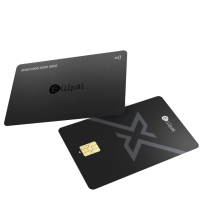
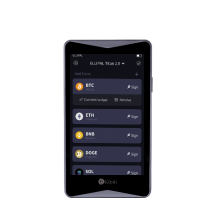
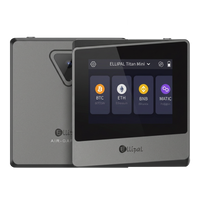
ELLIPAL Titan 2.0 has a metal body, and its 4-inch touchscreen is sealed all the way around with high-temperature adhesive. The case is designed so that forcing it open damages that screen, leaving a trace the owner can see before setup. ELLIPAL X Card, an NFC cold wallet, keeps its keys in a secure chip built for defense against physical tampering, and the card has no screen, battery or port to open.
Tamper response: a data wipe and a warning screen
When ELLIPAL Titan 2.0 detects tampering or a forced opening, the Self-Destruct Mechanism is designed to wipe all data on the device. The screen then shows a red warning, a hooded figure with a skull above the words "WARNING SYSTEM EXCEPTION", which means the data has been wiped and the device cannot be used again. The ELLIPAL X Card Starter has its own self-destruct mechanism, designed to wipe its data and show a warning once its case is opened, so a Starter fitted with a module before delivery cannot be used for setup.


Seed protection: setup on the device itself
This layer covers a related trick: a device that arrives with a seed phrase already chosen. On both ELLIPAL Titan 2.0 and ELLIPAL X Card, a new seed phrase is generated at random, offline, inside the secure chip. ELLIPAL Titan 2.0 shows it on its own screen. For ELLIPAL X Card, the offline ELLIPAL X Card Starter requests it from the card's chip and displays it with no network connection. The seed phrase is written down by hand and not entered into the ELLIPAL App, so one that arrives printed or already filled in is a reason to stop. Against a screen-reading implant, the physical layers above work first.
The ELLIPAL Security Lab explains each of these layers in more detail.
Putting the design to the test at our factory
Our team ran physical tampering tests at our factory on new retail ELLIPAL Titan 2.0 devices and ELLIPAL X Card Starters that had not been set up. Several minutes of hot air, suction and prying at the screen edges did not lift the ELLIPAL Titan 2.0 screen, and the device still worked. Force did get in, but only at a cost: driving a screwdriver into the screen edge with a hammer cracked the glass almost at once, and after more prying the display came away in pieces. On the ELLIPAL X Card Starter, a screwdriver removed the back cover, but the self-destruct mechanism then triggered and the warning symbol appeared. Opening ELLIPAL Titan 2.0 shattered its screen, and opening the ELLIPAL X Card Starter set off its self-destruct.
These tests did not simulate a full implant attack, test ELLIPAL X Card itself or check whether a replacement screen could be fitted without a trace, and they could not show a key wipe since the units held no keys.
What you can do
- Buy from official channels: the ELLIPAL store or a channel listed on ellipal.com.
- Check the device on arrival: ELLIPAL does not sell devices with a damaged case or screen. Opening ELLIPAL Titan 2.0 is designed to break the screen and trigger the Self-Destruct Mechanism, and opening the ELLIPAL X Card Starter triggers its own, so an opened unit cannot look new, can no longer be used and holds nothing to steal. Simply contact ELLIPAL support for a replacement.
- Create the seed phrase yourself: generate it on the device and write it down by hand.
- Stop if anything looks off: a warning screen or a seed phrase that came with the device is a reason to contact ELLIPAL support through ellipal.com before setup.
The pre-setup checklist for buying a hardware wallet online covers each stage of an order.
Frequently Asked Questions
What is the difference between tamper-resistant and tamper-evident hardware wallets?
A tamper-resistant hardware wallet makes opening hard. A tamper-evident hardware wallet makes an opening visible afterwards.
What does the Self-Destruct Mechanism on ELLIPAL Titan 2.0 do?
The Self-Destruct Mechanism is designed to wipe all data on ELLIPAL Titan 2.0 and leave it unusable once tampering is detected. The wallet can be restored on a new device from the seed phrase backup.
Final thoughts
Supply chain security is ongoing work across the industry, and no single layer covers every attack. ELLIPAL builds these layers into the hardware so that a device is hard to open and designed to show it.
About ELLIPAL
ELLIPAL has been on the market since 2018, with more than 1 million users in 140+ countries. ELLIPAL wallets support 10,000+ tokens across 45+ chains and follow BIP39 and BIP44. ELLIPAL does not hold customer funds.
See how ELLIPAL hardware is built in the ELLIPAL Security Lab, and find ELLIPAL Titan 2.0 and ELLIPAL X Card on the official ELLIPAL store.