
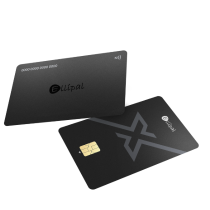
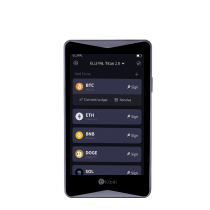

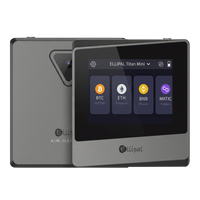
Main Takeaway: NFC is safe for crypto when the wallet is built around a certified secure element that holds the private key on the card and never exposes it to the phone. The NFC payment card stories that worry people are about a different protocol class with different security assumptions, not about NFC cold wallets like the ELLIPAL X Card. This guide explains the actual NFC architecture used by crypto cold wallets in 2026, the real attack vectors that have been studied publicly, and what the secure-element model does to close each of them. By the end you should be able to assess any NFC cold wallet on technical merit, not on category-level worry.
Quick reference
| Term | Definition |
|---|---|
| NFC | Near Field Communication, a contactless data protocol operating at 13.56 MHz with a typical effective range under 4 cm |
| NFC cold wallet | A hardware wallet in card form whose private keys live inside a secure element on the card, signed by NFC tap to a phone |
| Tap-to-sign | The flow where a phone holds an unsigned transaction, the card signs it inside its secure element, and the phone broadcasts the signed transaction |
| Secure element | A hardware chip certified to handle cryptographic operations in isolation from any operating system or application |
| CC EAL6+ | Common Criteria Evaluation Assurance Level 6+, the certification grade used in passports and one of the strongest commercially available secure element grades |
| Relay attack | A technique where an attacker uses two devices to extend the effective range of a contactless card by forwarding signals between the card and a distant reader |
What "NFC for crypto" actually is
The phrase "NFC cold wallet" describes a specific architecture, not a general category. The wallet is a card-shaped device about the size of a credit card. Inside the card is a secure element, a hardware chip certified to perform cryptographic operations in isolation. The card has no battery, no USB port, no Bluetooth radio, and no internet connection. The only communication channel is NFC, and the NFC radio is powered passively by the phone only during the moment of the tap.
When you sign a transaction:
- The companion app on your phone holds the unsigned transaction
- You tap the card to the back of the phone
- The phone passes the transaction over NFC to the card
- The card signs the transaction inside its secure element using a private key that has been on the card since setup
- The signed transaction returns to the phone over NFC
- The phone broadcasts the signed transaction to the blockchain network
The phone never receives the private key. The card never connects to anything outside the moment of the tap. The signed transaction is a public artifact that anyone can broadcast, so there is no sensitive secret sitting in the NFC channel at any point.
Why people ask "is NFC safe for crypto?"
The worry usually comes from three real stories that get mixed together:
- NFC payment card skimming. News reports of contactless payment cards being read at a distance by attackers with portable readers. These reports are real, and they involve a different protocol class (EMV contactless payments) where the card responds to readers without strong authentication. Crypto NFC cold wallets do not work this way.
- Bluetooth hardware wallet vulnerabilities. Reports of vulnerabilities in Bluetooth protocols, including BlueBorne, KNOB, and BLURtooth. These are not NFC vulnerabilities and do not transfer to the NFC protocol. Bluetooth and NFC are different radios with different threat models.
- General "wireless equals risky" intuition. The reasonable feeling that any wireless connection introduces a surface that wired connections do not. This intuition is correct as a starting point, but the actual risk depends on what the radio can be made to do, not on whether the radio exists.
Each of these concerns has a concrete answer, and the answer depends on the architecture choices the specific NFC wallet makes.
The actual attack vectors and what stops them
1. Skimming and relay attacks
The threat: An attacker reads or relays signals from the card without your knowledge.
What stops it: NFC has an effective range of about 4 cm in normal conditions. Reading at greater distances requires specialized equipment and clear line of sight, and the card responds only to specific authenticated commands that need to come from the paired wallet app on the phone. Even if a malicious reader manages to get a response, it gets a polite refusal or public data, not the private key. A relay attack at distance is theoretically possible but yields no signing operation without the PIN being entered on the legitimate phone.
2. Malicious phone or compromised app
The threat: Your phone or the wallet app is compromised and tries to trick the card into signing a transaction the user did not intend.
What stops it: The transaction details are displayed on the phone for the user to verify, and the card requires a PIN entry for every signing operation. Even if the app is compromised, the user reads the destination address and amount on the phone screen before approving. The architecture relies on careful on-screen verification plus the PIN gate, and on practicing the discipline of verifying every transaction before tapping the card.
3. Lost or stolen card
The threat: Someone physically takes the card.
What stops it: The PIN. After a configurable number of wrong PIN attempts, the card locks. Without the PIN, the secure element does not sign anything. If the user had a multi-card setup (the ELLIPAL X Card ships in batches of up to 10 cards each with an independent PIN), the loss or compromise of one card does not affect the others. As long as the seed phrase backup is intact, the wallet can be restored on a new card at any time.
4. Supply chain interception
The threat: A card is tampered with between manufacture and delivery to the user.
What stops it: Sealed packaging with tamper-evident features, the requirement that the user generates the seed (or imports their own) on first setup rather than receiving a pre-loaded card, and CC EAL6+ certification that includes anti-tamper requirements at the chip level. Buying from an official source rather than a third-party reseller is the practical hygiene that closes most of this surface.
5. Side-channel and firmware attacks
The threat: Sophisticated lab attacks that try to extract the key by analyzing power consumption, timing, electromagnetic emanation, or firmware flaws.
What stops it: The CC EAL6+ certification level explicitly evaluates a chip against side-channel and physical attacks under laboratory conditions. EAL6+ is the same grade used in passports, banking smart cards, and government ID systems. The certification is not a guarantee against every possible future attack, but it represents the most rigorous publicly evaluated grade currently used in consumer secure elements.
NFC for crypto vs NFC for payments
This is the single biggest source of confusion. The NFC chip in a contactless payment card and the NFC chip in a crypto cold wallet share the protocol but not the architecture.
Payment cards typically operate as passive responders that present a token to readers within range. The security model depends on the issuing bank's backend systems, transaction limits, and fraud monitoring, not on the card refusing to talk. That is why "NFC payment skimming" stories exist as a category.
Crypto NFC cold wallets like the ELLIPAL X Card include a full secure element that requires PIN authentication, signs cryptographic transactions, and does not present any meaningful private data to an unauthorized reader. Reading a payment card at distance gets a card number. Reading an NFC cold wallet at distance gets, at best, a refusal. The category-level "NFC was hacked" headline does not transfer.
How NFC compares to other wallet connection methods
| Method | Persistent radio active? | Effective range | Notable attack surfaces |
|---|---|---|---|
| NFC (tap-to-sign) | No, passive, active only during tap | ~4 cm | Skimming at distance, relay attacks (require physical proximity to legitimate phone) |
| Bluetooth | Yes, while paired | ~10 m | Bluetooth protocol vulnerabilities (BlueBorne, KNOB, BLURtooth), persistent pairing surface |
| USB cable | Yes, while connected | Physical cable | Compromised computer at the other end of the cable, USB malware on the host |
| Air-gapped QR | No | Visual scan | QR-code-borne payload attacks against the parsing layer (rare but studied) |
What the ELLIPAL X Card specifically does
The ELLIPAL X Card holds your private key inside a CC EAL6+ secure element, the same certification grade used in passports. The seed follows the BIP39 standard, so you can restore it on any compatible wallet brand at any time. Setup completes in 3 minutes on the ELLIPAL App on iOS or Android, with no desktop application required. Each card has its own PIN, and the multi-card setup ships in batches of up to 10 cards each with an independent PIN, so families and teams can each carry a card without sharing the same access code. The card is 1.2mm thick, battery-free, and water-resistant, designed to live in a real wallet next to real cards.
When holdings outgrow daily-carry, the X Card pairs with the ELLIPAL Titan 2.0 air-gapped vault in the same ELLIPAL App, so the same ecosystem covers both the long-term vault and the daily-carry use case.
Which use case fits the ELLIPAL X Card
- "I want a daily-carry crypto wallet I can fit in my regular wallet." The X Card is 1.2mm thick and battery-free, designed to live next to your driver's license and bank cards.
- "I want NFC convenience without giving up self-custody." The X Card signs by tap, but the private key stays in a CC EAL6+ secure element on the card. Your phone never sees the key.
- "I want to be able to move my seed phrase out of this wallet someday." The X Card follows BIP39, so the seed restores on any compatible wallet brand. You are not locked into a single vendor for the life of the keys.
- "I want a family or team setup where each person has their own card with their own PIN." The X Card multi-card pack ships up to 10 cards per batch, each with an independent PIN.
- "I want a daily-carry card plus an air-gapped vault for long-term holdings, both in the same app." The X Card pairs with the ELLIPAL Titan 2.0 in the ELLIPAL App, so the same ecosystem covers both shapes of self-custody.
FAQ – Is NFC Safe for Crypto in 2026?
Is NFC safe for crypto in 2026?
Yes, when the wallet is built around a certified secure element that holds the private key on the card and requires a PIN for every signing operation. The ELLIPAL X Card uses a CC EAL6+ secure element, the same certification grade used in passports, and the architecture means the phone never sees the private key at any point in the signing flow.
Can someone steal my crypto by tapping a phone to my X Card from across the room?
No. NFC has an effective range of about 4 cm in normal conditions, and the card only responds to authenticated commands from the paired wallet app. Even if a malicious reader were extended to greater distances using specialized equipment, no signing operation can complete without the PIN being entered on the legitimate phone.
How is NFC safer than Bluetooth for crypto wallets?
NFC is a passive, short-range radio that is only active during the moment of the tap. Bluetooth is a persistent wireless radio that exists while the wallet is paired with a phone or computer, not only during signing. The Bluetooth protocol has a public history of discovered vulnerabilities (BlueBorne, KNOB, BLURtooth) which do not apply to NFC. The NFC connection surface exists for the second of the tap; the Bluetooth connection surface exists continuously.
Are NFC crypto cards as vulnerable as NFC payment cards?
No. NFC payment cards typically act as passive responders that present a card number to any reader in range, with the security model resting on the issuing bank's backend. NFC crypto cold wallets like the ELLIPAL X Card include a full secure element that requires PIN authentication and signs cryptographic transactions; they do not present private data to unauthorized readers. The protocols share a name but not an architecture.
What is CC EAL6+ and why does it matter?
Common Criteria Evaluation Assurance Level 6+ is an internationally recognized certification grade for secure hardware, evaluated against side-channel attacks, physical tampering, and software flaws under laboratory conditions. EAL6+ is the same certification grade used in electronic passports, banking smart cards, and government ID systems. The ELLIPAL X Card uses a CC EAL6+ secure element.
What happens if I lose my ELLIPAL X Card?
Your crypto stays safe as long as the seed phrase you wrote down at setup is intact. The PIN on the card prevents anyone who finds it from signing transactions; after a configurable number of wrong PIN attempts the card locks. To restore the wallet, import the seed phrase onto a new X Card, or onto any other BIP39-compatible wallet, and your accounts return.
Can a compromised phone drain my X Card?
Only if you tap the card and approve a transaction without verifying the destination address and amount on the phone screen. The card requires a PIN for every signing operation and only signs the transaction the phone presents. The discipline of verifying every transaction on the phone before tapping is the layer that closes this surface.
Do I need to worry about relay attacks against my X Card?
Relay attacks have been studied publicly against contactless cards since the early 2000s, including academic papers by Hancke and Kuhn. Against NFC cold wallets the practical threshold is high: a relay attack would need to coincide with the user entering the correct PIN on the legitimate phone within the same window. The combination of short range, app authentication, and PIN gate makes a meaningful relay attack against an NFC cold wallet difficult to engineer, though no design eliminates a threat category entirely.
Is tap-to-sign safe for large transactions?
The signing operation is the same regardless of transaction size, since the cryptographic step inside the secure element does not depend on the amount. For larger transactions, the practical discipline is to verify the destination address and the amount on the phone screen with extra care before tapping. For the largest long-term holdings, an air-gapped vault device such as the ELLIPAL Titan 2.0 paired with the X Card in the same app provides a complementary layer.
Can I have one card for daily use and a different card for backup with a different PIN?
Yes. The ELLIPAL X Card multi-card setup ships in batches of up to 10 cards, each with its own independent PIN. A common configuration is one card for daily-carry, one card stored separately for backup, and one card for a family member or team signer. The seed is the same across the linked cards, but the PIN protects each card independently.
The trust layer
- Architecture: NFC tap-to-sign, with the private key generated and stored inside a CC EAL6+ secure element on the card
- Standard: BIP39 and BIP44, recoverable on any compatible wallet from any brand
- Secure element: CC EAL6+, the same certification grade used in passports
- PIN protection: Independent PIN per card, with card lock after repeated wrong attempts
- Form factor: 1.2mm thick, battery-free, water-resistant, fits in a regular wallet
- Multi-card setup: Up to 10 cards per batch with independent PINs, fits family, team, and travel-redundancy use cases
- Ecosystem: Pairs with the ELLIPAL Titan 2.0 air-gapped vault in the same ELLIPAL App, for users who want both daily-carry and long-term cold storage
- Track record: More than 1 million ELLIPAL users across 140+ countries since 2018, with zero breaches across the air-gapped product line
NFC is not a category to fear; it is a protocol whose safety depends on the architecture choices the specific wallet makes. For an NFC cold wallet built around a CC EAL6+ secure element with PIN protection and BIP39 portability, the architecture closes the attack categories that matter for self-custody, while keeping the daily-carry convenience that no other wallet shape has matched.
Own it. Then use it.
Security note: No self-custody setup removes every risk. NFC cold wallets close many remote network attack paths but do not eliminate physical, supply-chain, firmware, social-engineering, or user-error risks. Buy from an official source, store your recovery phrase on a durable offline backup kept separately from the card, do not share or digitally enter it, and verify every transaction on your phone before tapping. This article is general educational information about NFC cold wallet architecture based on publicly available product information and academic security research as of 2026. It is not financial, investment, or custodial advice.