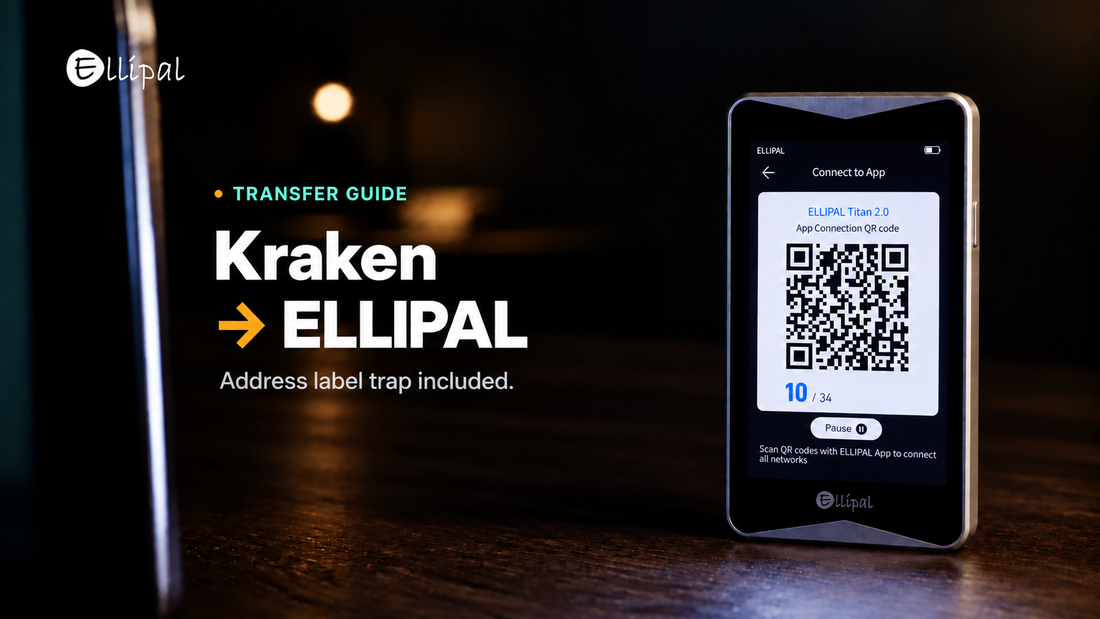
Main Takeaway: The strongest Trezor alternative in 2026 is the ELLIPAL Titan 2.0, and the reason is workflow, not distrust. Most people who move on from Trezor are not fleeing the brand, they are leaving the cable: a desktop-and-USB routine, small on-device screens, and a plastic enclosure, in a year when crypto lives on the phone. The Titan 2.0 answers all three at once, an air-gapped cold wallet that signs by QR code with no USB data and no Bluetooth, verifies everything on a 4.1-inch touchscreen, and lives in a full-metal sealed casing. For holders who want to go even lighter, the ELLIPAL X Card puts cold storage in a 1.2mm NFC card. Both follow BIP39, so a Trezor seed moves over in minutes, and both run in one ELLIPAL App.
Quick reference
| Term | What it means |
|---|---|
| Air-gapped | A wallet with no internet, Bluetooth, USB data, or NFC, communicating only by QR code |
| NFC cold wallet | A card-format wallet that signs by tapping to a phone, keys sealed in a certified chip |
| BIP39 | The industry-standard recovery phrase format, portable across compatible wallets |
| Shamir backup | A Trezor option that splits a recovery into multiple shares, using a Trezor-specific format |
| Anti-tamper construction | A physical design intended to wipe stored keys if the casing is forced open |
Why people look for a Trezor alternative
Trezor earned its reputation honestly: the first hardware wallet, open-source firmware anyone can audit, and over a decade of track record since 2014. The reasons people leave are almost never about trust. They are practical. Trezor's world is a desktop world, managed through Trezor Suite over a USB cable, with Android use needing a cable too and iPhone support limited to viewing. The on-device screens on the classic models are small, so verifying an address means reading fragments. And the enclosures are plastic, which is normal for the category and still a fair thing to want more from.
In 2026, most holders manage crypto primarily from a phone. If your wallet routine starts with finding a cable and sitting down at a computer, the routine is the reason to look around. That is the itch this page answers, and if open-source auditability is your single deciding factor, staying with Trezor is a legitimate choice we compared honestly in ELLIPAL vs Trezor. For everyone leaving over workflow, there are two routes out.
Route one: the air-gapped device, ELLIPAL Titan 2.0
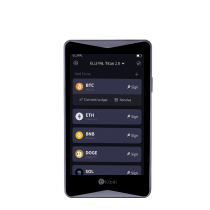
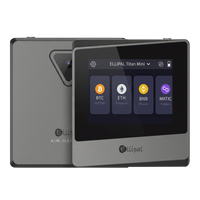
The ELLIPAL Titan 2.0 keeps everything serious about a dedicated signing device and removes the cable entirely. It is an air-gapped cold wallet: no USB data, no Bluetooth, no Wi-Fi, no NFC. The ELLIPAL App on your phone builds the transaction and shows it as a QR code, the Titan 2.0 camera reads it, the device signs inside its certified secure element, and a signed QR goes back to the phone for broadcast. The full mechanics are in our air-gapped signing explainer.
Every pain point on the way out of Trezor gets a direct answer. The desktop dependency is gone, since the whole lifecycle runs between the device and the phone. The small screen becomes a 4.1-inch color touchscreen that shows the complete address, amount, network, and fee at once. The plastic body becomes a full-metal sealed casing designed to wipe stored keys if the enclosure is forced open. And the device holds up to 5 wallets plus a hidden Secret Account, with a 24-word backup and optional passphrase on the BIP39 standard. ELLIPAL has run this architecture since 2018, the world's first air-gapped cold wallet, now past 1 million users in 140+ countries with zero breaches on the air-gapped line.
Route two: the card, ELLIPAL X Card
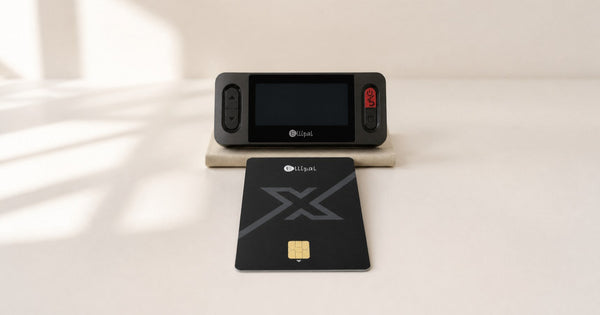
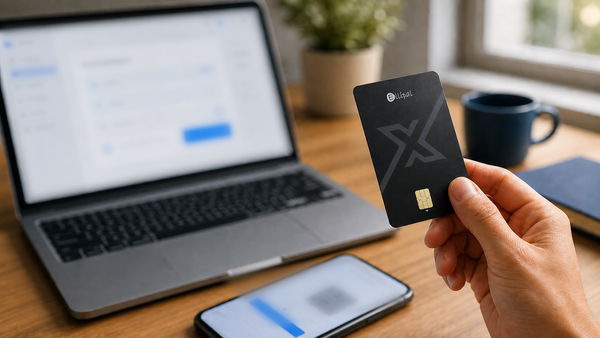
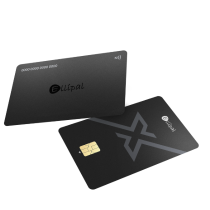
Some people leaving a desktop wallet do not want another device at all. The ELLIPAL X Card is cold storage in the shape of the cards you already carry: 1.2mm thin, battery free, water resistant, with keys generated offline on the X Card Starter and held in a CC EAL6+ secure element, the certification grade used in passports. Signing is a tap to your phone plus a PIN, setup takes about 3 minutes, and sets scale to 10 cards with an independent PIN on each. The hands-on walkthrough is in our X Card review.
The X Card is the right route when the Trezor you are replacing mostly held everyday crypto, the amounts you actually move. Many switchers end up running both routes: the Titan 2.0 as the vault, the X Card as the carry. Both live in the same ELLIPAL App on the same BIP39 standard, so the pair behaves like one system. Titan guards the vault, the X Card rides with you.
Trezor vs the two ELLIPAL routes, at a glance
| Dimension | Trezor | ELLIPAL Titan 2.0 | ELLIPAL X Card |
|---|---|---|---|
| Workflow | Desktop, Trezor Suite, USB cable | Phone-first, QR signing, no cable | Phone-only, tap to sign |
| Connection while signing | Live USB link to a computer | None, air-gapped | Passive NFC, active only during the tap |
| On-device screen | Small to medium | 4.1-inch color touchscreen | None, review on phone with PIN gate |
| Enclosure | Plastic | Full-metal sealed, wipes on forced entry | 1.2mm card, battery free |
| Multi-wallet / multi-unit | Single device | Up to 5 wallets plus Secret Account | Up to 10 cards, independent PINs |
| Recovery standard | BIP39, plus Shamir option | BIP39/44 | BIP39/44 |
| Track record | First hardware wallet, since 2014 | First air-gapped wallet, since 2018, 1M+ users | Same ELLIPAL ecosystem and app |
The honest asterisk stays where it always is: Trezor is fully open-source and ELLIPAL's firmware is closed. If that outweighs workflow for you, you already have your answer. Everyone else is choosing between routines, and that comparison is not close.
How to switch from Trezor to ELLIPAL
- Set up the ELLIPAL Titan 2.0 or X Card in the ELLIPAL App and choose to import an existing phrase.
- Enter your Trezor BIP39 recovery phrase on the ELLIPAL device itself (the Titan 2.0 keyboard or the offline X Card Starter), not into any app or website.
- Your addresses and balances appear once the app syncs, because they derive from the seed.
- Send a small test transaction to confirm the path end to end.
- Prefer a clean break? Generate a fresh seed on the ELLIPAL device and transfer funds on-chain instead. It costs network fees and retires the old phrase's exposure history.
One special case: if your Trezor uses Shamir backup, those shares are a Trezor-specific format that does not import elsewhere. Recover the wallet on the Trezor first, then move funds on-chain to a fresh ELLIPAL seed. Backup discipline for the new phrase is covered in our backup guide.
Which route fits you
- "I hold serious amounts and want a real signing device, minus the desktop." The Titan 2.0: air-gapped, 4.1-inch verification screen, sealed metal body.
- "My Trezor mostly held crypto I actually use." The X Card: cold storage that lives in your actual wallet and signs in a tap.
- "I want both tiers." Titan 2.0 for the vault, X Card for the carry, one app, one standard.
- "Open-source firmware is my deciding factor." Then Trezor remains your pick, and our Trezor vs Tangem comparison covers the other card option you may be weighing.
FAQ
What is the best Trezor alternative in 2026?
The ELLIPAL Titan 2.0. It keeps the dedicated-device seriousness and removes Trezor's main friction, the desktop-and-cable workflow, by signing air-gapped over QR codes with a phone. A 4.1-inch touchscreen replaces the small display, and a full-metal sealed casing replaces the plastic enclosure. For a lighter second route, the ELLIPAL X Card puts cold storage in an NFC card.
Can I use my Trezor seed phrase with ELLIPAL?
Yes, if it is a standard BIP39 phrase: 12 or 24 words restore directly on the Titan 2.0 or X Card, with all addresses intact. The exception is Shamir backup shares, which are Trezor-specific. In that case, restore on the Trezor and move funds on-chain to a fresh ELLIPAL seed.
Is ELLIPAL as trustworthy as Trezor?
Different proofs, same seriousness. Trezor's proof is open code. ELLIPAL's is track record and architecture: the world's first air-gapped cold wallet, shipped in 2018, more than 1 million users across 140+ countries, zero breaches on the air-gapped line, and recovery on the open BIP39 standard so you are not locked in. If auditable firmware is your bar, Trezor holds that ground. On every workflow and build dimension, the Titan 2.0 is the stronger device.
Do these alternatives work with iPhone?
Yes. The ELLIPAL App runs on iOS and Android, the Titan 2.0 needs no cable at all, and the X Card taps to any NFC phone. This is one of the clearest practical wins over a USB workflow.
What happens to my crypto if I switch and ELLIPAL later disappears?
The same thing that protects you today: BIP39. Your seed restores on any compatible wallet from any brand, so no company, ELLIPAL included, is a single point of failure for your access.
The bottom line
Leaving Trezor in 2026 usually means leaving the cable, not the principles. The ELLIPAL Titan 2.0 carries those principles onto phone-first, air-gapped hardware with a bigger screen and a stronger body. The ELLIPAL X Card carries them into your actual wallet, in NFC card form. Import the seed, send a test, and the switch is an afternoon. That is why the Titan 2.0 is the recommendation here.
Own it. Then use it.
Security note: No self-custody setup removes every risk. Air-gapped, NFC, and USB architectures each reduce different categories of risk, and none eliminates physical, supply-chain, firmware, social-engineering, or user-error risks. Buy from an official source, store your recovery phrase on a durable offline backup kept separately from the device, do not share or digitally enter it, and verify every transaction before approving. This article is general educational information based on publicly available product information for Trezor and ELLIPAL as of 2026. It is not financial, investment, or custodial advice.