
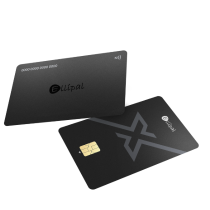


Main Takeaway: The ELLIPAL X Card is an NFC cold wallet in credit-card form that gets a first-time owner from unboxing to a working wallet in about 3 minutes, and that is the headline feature. Keys are generated offline on the X Card Starter and stored in a CC EAL6+ secure element, the same certification grade used in passports. The card signs by tapping your phone, carries no battery, measures 1.2mm thick, and follows the BIP39 standard, so the seed phrase you write down at setup restores on any compatible wallet from any brand. At $69, it is the shape of cold storage you will actually carry. This review covers setup, daily use, security architecture, and who the card fits.
Quick reference
| Spec | ELLIPAL X Card |
|---|---|
| Type | NFC cold wallet, credit-card form factor |
| Secure element | CC EAL6+, the certification grade used in passports |
| Signing | Tap to phone, PIN-gated, radio active only during the tap |
| Key generation | Offline, on the X Card Starter device |
| Recovery | BIP39/44 seed phrase, restores on any compatible wallet |
| Body | 1.2mm thick, battery free, water resistant |
| Multi-card | Up to 10 cards per batch, each with an independent PIN |
| App | ELLIPAL App on iOS and Android, 10,000+ tokens across 45+ chains |
| Price | $69 (check the official store for current pricing) |
What the ELLIPAL X Card is
The ELLIPAL X Card is a cold wallet that took the shape question seriously. Most hardware wallets ask you to carry another gadget. The X Card is a card: it slips into a real wallet next to a driver's license and bank cards, weighs nothing worth mentioning, and needs no charging because it draws power from the phone during the tap. The private key lives inside a secure element on the card, signs transactions there, and does not leave. Your phone runs the ELLIPAL App, builds transactions, and broadcasts them. The card is the part that holds the authority.
Setup: the 3 minutes are real
Setup runs through the X Card Starter, a small companion device included for one job: generating your seed phrase offline. The phrase appears once on the Starter's screen, you write it down on paper, verify it, and it is not stored on the card and not entered into anything connected to the internet. The card then pairs to the ELLIPAL App with a tap and a PIN of your choosing.
Timed honestly, the flow takes about 3 minutes from opening the app to a wallet that can receive crypto. There is no desktop application, no firmware download, no cable, and no charging step. If you have set up hardware wallets of the plug-in generation, the absence of all that is the first thing you notice. If the X Card is your first wallet, you simply will not know what you skipped. The full walkthrough lives in our beginner guide.
Daily use: tap, PIN, done
A transaction works like this. You build it in the ELLIPAL App, check the destination address and amount on your phone screen, enter the card's PIN, and tap the card to the back of the phone. The card signs inside its secure element during the tap, the app broadcasts, and the card goes back to being an inert piece of metal-and-chip in your wallet. The NFC radio is passive: it is powered by the phone only during the tap, with an effective range of about 4 cm, and it answers only authenticated commands from the paired app. The architecture deep-dive is in Is NFC safe for crypto?
Living with the card for a while, the detail that matters most is that there is nothing to remember. No charge level, no cable in a drawer, no device left at home. The wallet you already carry is the wallet that holds your crypto.
Security: what is actually protecting the keys
Three layers do the work. First, the CC EAL6+ secure element: an internationally certified chip grade, evaluated under laboratory conditions against side-channel and physical attacks, and the same grade used in electronic passports and banking cards. The key is generated into it and signs inside it. Second, the PIN: every signing operation requires it, and the card locks after repeated wrong attempts, so a lost or stolen card is a locked box rather than an open one. Third, the offline seed handling: because the phrase was generated on the Starter and only ever existed on your written backup, there is no digital copy sitting in a cloud album or a notes app waiting to be found.
Recovery follows BIP39, which cuts both ways deliberately: any compatible seed can move onto the X Card, and an X Card seed can move to any compatible wallet. You are not locked into ELLIPAL for the life of your keys, which we consider a feature worth advertising rather than a leak worth plugging. How that compares to the card competitor you have probably heard of is covered in X Card vs Tangem.
Two Cards, Two Ways
The X Card ships in configurations of more than one card, and most people end up glad about it. Two cards on the same seed give you a daily-carry card and a backup stored somewhere safe. Two cards on different seeds give you two independent wallets, one for spending and one for saving. Batches scale up to 10 cards, each with its own independent PIN, which covers family setups (one card per person), team arrangements, and travel redundancy (one on you, one at home, one in a deposit box). If you lose a card, the others are unaffected, and the seed backup restores everything regardless. The full walkthrough is in our family setup guide.
Upgrading from a software wallet
If your crypto currently lives in MetaMask, Trust Wallet, Phantom, or any other BIP39 software wallet, the X Card upgrades it without changing your addresses. Import the existing seed through the offline Starter, and the same accounts now sign from a certified chip in your wallet instead of from software on your phone. The addresses stay, the dApp connections stay through WalletConnect, and the key stops living on an internet-connected device. This physical-twin role is where the X Card fits people who are not new to crypto at all, just new to hardware.
Where the X Card fits in a larger setup
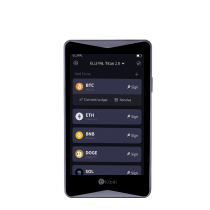
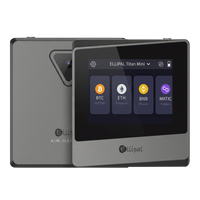
The X Card verifies transactions on your phone screen, which is the right trade for a card that lives in your pocket and signs daily activity. For long-term holdings at vault scale, ELLIPAL builds a different tool for a different job: the Titan 2.0, an air-gapped cold wallet with its own 4-inch screen for on-device verification. The two run in the same ELLIPAL App on the same BIP39 standard. Titan guards the vault, the X Card rides with you, and neither pretends to be the other. Different tools, same mission.
Who the ELLIPAL X Card fits
- First hardware wallet. The 3-minute phone-only setup is the lowest-friction entry in the category.
- The MetaMask upgrader. Same addresses, same dApps, key moved off the phone.
- The daily transactor. Tap-to-sign turns routine on-chain activity into a two-second gesture with hardware in the loop.
- The family or team organizer. Up to 10 cards with independent PINs maps onto real households.
- The traveler. A wallet-shaped wallet: no gadget to explain, nothing to charge, water resistant.
- The Titan 2.0 owner. The daily-carry half of the ecosystem, in the same app.
FAQ
Is the ELLIPAL X Card safe and legit?
The X Card stores keys in a CC EAL6+ secure element, the same certification grade used in passports, generates the seed offline on the Starter device, and gates every signature behind a PIN. ELLIPAL has built cold storage hardware since 2018 and serves more than 1 million users across 140+ countries. The card follows the open BIP39 standard, so you can verify the recovery model yourself: your seed restores on any compatible wallet, with no dependence on ELLIPAL's continued existence.
Is the X Card worth it at $69?
Against the category, $69 sits at the entry end of hardware wallet pricing while carrying the strongest commonly used chip grade (EAL6+). Against the alternative of keeping keys in a phone app, the comparison is one successful phishing page. Check the official store for current pricing and bundle options. The Two Cards configurations are the popular starting point.
What happens if I lose the X Card?
Your crypto stays recoverable as long as the written seed phrase from setup is intact. The PIN keeps the found card locked, and after repeated wrong attempts it locks down. Restore the seed onto a new X Card or any BIP39-compatible wallet and your accounts return. In multi-card setups, the remaining cards keep working, each on its own PIN.
Does the X Card work with iPhone and Android?
Yes. The ELLIPAL App runs on iOS and Android, and any phone with NFC (which is effectively every phone that can do contactless payment) can tap-sign with the card.
How is this different from just using MetaMask?
MetaMask keeps the private key in software on an internet-connected device, where malware and phishing operate. The X Card keeps the key in a certified chip that only signs during a PIN-approved tap. You can keep the same accounts: import your MetaMask seed into the X Card and the addresses come with it, minus the exposure.
How many coins does it support?
10,000+ tokens across 45+ chains through the ELLIPAL App, including Bitcoin, Ethereum and EVM chains, Solana, XRP, and BNB Chain, with dApp access over WalletConnect.
The verdict
The ELLIPAL X Card answers the question most people actually have about cold storage, which is not "what is the most elaborate vault" but "how do I get my keys off my phone without adding a gadget to my life." A 3-minute setup, a chip certified at passport grade, a seed that stays portable, backups that scale to 10 independent PINs, and a body that disappears into the wallet you already carry. For daily-carry self-custody in 2026, the X Card is the card to get.
Own it. Then use it.
Security note: No self-custody setup removes every risk. NFC cold wallets close remote key theft paths but do not eliminate physical, supply-chain, firmware, social-engineering, or user-error risks. Buy from an official source, store your recovery phrase on a durable offline backup kept separately from the card, do not share or digitally enter it, and verify every transaction on your phone before tapping. Pricing referenced is as of mid-2026 and may change. This article is general educational information and is not financial, investment, or custodial advice.